
Selecting Milling Cutters for Wood CNC Milling Machines: A Comprehensive Guide for Professional Users
Achieving successful results on wood CNC milling machines is not limited to simply having a powerful machine. Choosing the right milling cutter, determining the appropriate tool geometry for the material to be processed, using the appropriate speed and progress values, and regular maintenance are the cornerstones of quality production. With the widespread adoption of CNC […]
Achieving successful results on wood CNC milling machines is not limited to simply having a powerful machine. Choosing the right milling cutter, determining the appropriate tool geometry for the material to be processed, using the appropriate speed and progress values, and regular maintenance are the cornerstones of quality production.
With the widespread adoption of CNC technologies in the woodworking industry, production processes have become both faster and more precise. Today, CNC milling machines are actively used in many fields, from furniture production to decoration applications, from door manufacturing to kitchen cabinet production. However, even the most advanced CNC machine cannot deliver the desired performance if the correct milling cutter is not used. The cutting quality, surface smoothness, processing time, and tool life largely depend on the characteristics of the milling cutter used.
Choosing the right milling cutter not only ensures the production of higher-quality products, but also reduces production costs, reduces tool change times and contributes to more efficient operation of the machine. For businesses engaged in mass production, selecting the right tooling provides a significant long-term competitive advantage.
In this comprehensive guide, we will examine in detail the basic criteria to be considered in the selection of milling cutters used in wood CNC milling machines, professional application recommendations and tips that will increase production efficiency.
Why Is CNC Milling Cutter Selection So Important?
The milling cutter is the most critical component of the CNC machine that directly contacts the workpiece and performs the cutting operation. The geometry of the blade used, material quality, cutting edge structure, and coating technology affect many factors, from cutting quality to machine load.
An improperly selected milling cutter may cause the following problems:
- Burr formation on the cutting surface
- Breakage occurring at the edges
- Deterioration of the tool in a short time
- Excessive strain on the machine spindle motor
- Vibration occurring during cutting.
- Observation of burn marks on the workpiece
- Extension of production time
- Choosing the right tool means cleaner cuts, lower waste rates, and longer tool life.
The choice of milling cutter should be made according to the material to be processed.
Not all wood-based panels have the same physical properties. MDF, raw chipboard, melamine-faced boards, plywood, solid wood, OSB, and composite panels have different densities and fiber structures. Therefore, it is not possible to achieve the same quality in all materials with a single type of milling cutter.
A router bit used on solid wood may cause unwanted fractures on laminate-faced MDF. Similarly, a tooling system preferred for MDF with a fine fiber structure may not perform adequately on hardwoods.
Businesses engaged in professional manufacturing maintain quality standards by creating different tool sets based on the material used in the production line.
Why Are Carbide Milling Cutters More Preferred?
The most commonly used milling cutters in the woodworking industry are manufactured from solid carbide material. Carbide tips maintain their sharpness for a long time thanks to their high hardness and deliver consistent performance even under intense production conditions.
The advantages of solid carbide end mills are as follows:
- Longer service life
- High wear resistance
- Clean cutting quality
- Lower maintenance requirements
- Suitable for mass production
- Stable operation at high speeds
- Carbide milling cutters, especially in CNC nesting machines and panel processing centers, provide significant cost advantages to businesses.
Applications of Spiral Milling Cutter Bits
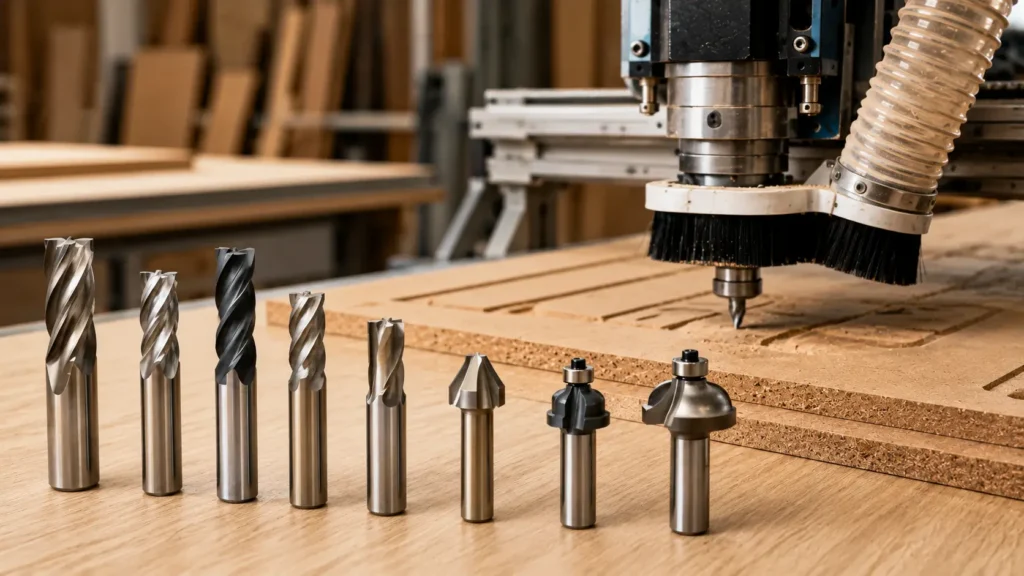
Spiral milling cutters are one of the most preferred product groups in the CNC industry, thanks to their special cutting geometries that facilitate chip evacuation.
Spiral ends with Up Cut (Up Cut) carry the chip up and give successful results in grooving and deep channel operations.
Down Cut models, on the other hand, reduce the upper surface breakage to a minimum, especially on laminate and melamine-coated boards.
Compression mills, on the other hand, deliver professional results on double-sided coated panels because they can cleanly cut both the top and bottom surfaces simultaneously.
Selecting the appropriate spiral structure for the production process directly affects both surface quality and processing speed.
The Relationship Between Milling Diameter and Cutting Performance
The diameter of the milling cutter determines not only the cutting width but also the tool’s durability and vibration level.
Small-diameter end mills provide an advantage for fine detail work, while large-diameter end mills offer higher rigidity and operate more stably during long cuts.
When selecting the correct diameter, the following criteria should be considered:
- Part size to be machined
- Channel width
- Cutting depth
- Machine spindle power
- Feed rate to be used
- Using a diameter larger than necessary not only does not provide efficiency, but can also lead to unnecessary energy consumption.
The cutter length and total tool length must be calculated accurately. Many users may focus solely on the milling cutter diameter while ignoring the cutter length. However, the cutting length of the tool must be appropriate for the thickness of the material to be processed.
Using a tool that is longer than necessary;
It may increase vibration.
It may reduce cutting precision.
It may shorten tool life.
May adversely affect surface quality.
Short and rigid tools operate as stably as possible. Therefore, it is recommended to choose only milling cutters with the required cutting length.
Shaft Diameter is Important for Machine Safety
The shaft diameter of the milling cutter ensures safe retention of the tool within the collet chuck. When the wrong shaft size is used, the tool may oscillate and cause damage to both the workpiece and the machine.
Although the shaft diameters most commonly used in professional CNC machines vary according to production requirements, each tool must be fully compatible with the machine’s clamp system.
Regular cleaning of the collets and replacement of worn-out collets is also one of the important maintenance practices that directly affects tool life.
Revolution and Feed Rate Must Be Properly Balanced
The performance of a milling cutter does not solely depend on tool quality. The spindle speed and feed rate set in the CNC program also directly affect the cutting result.
Using low feed rates at very high speeds may cause burn marks. On the contrary, excessive feed rate at low speed can cause tool breakage or distortions in the cutting surface.
Determining the appropriate cutting parameters for each material type both extends tool life and ensures higher quality production.
Advantages of Coated Milling Cutters
Thanks to advancing tool technologies, many milling cutters today are manufactured with special surface coatings. These coatings reduce friction while increasing wear resistance.
The main advantages offered by coated milling cutters are as follows:
- Lower temperature formation
- Longer sharpness retention
- Cleaner work on resinous woods
- Lower energy consumption
- Higher production capacity
- In high-volume manufacturing facilities, coated tools can provide significant long-term cost advantages.
Regular Maintenance of Milling Cutters Increases Efficiency
Even the highest quality milling cutter wears out over time. Resin, chips, and adhesive residues can accumulate in the cutting edges and cause performance loss.
Regular cleaning and maintenance ensures that the equipment operates close to its original performance.
Thanks to regular maintenance;
Cutting quality is maintained.
Engine load is reduced.
Tool change frequency decreases.
Continuity of production is ensured.
The fire rate decreases to a minimum level.
The Most Common Mistakes Made by CNC Operators
A significant portion of problems encountered during production stems from improper tool usage. The most common mistakes include continuing to work with a Decayed milling cutter, using the same tool for each material, choosing incorrect speed and feed values, neglecting clamp maintenance, and choosing a cutter length that is longer than necessary.
These errors not only reduce tool life, but can also pose a risk to occupational safety.
Choosing the right milling tool for furniture manufacturers, carpenters’ workshops, interior architecture firms and industrial production facilities means lower production costs, less waste, higher cutting accuracy and longer equipment life. By combining the right processing parameters with high-quality equipment, enterprises can both increase the production speed and offer products with impeccable surface quality to their customers. Dec.
For long-term success, it is of great importance to invest not only in the CNC machine, but also in the quality of the milling cutters used and the correct tool management. Choosing the right tool is an indispensable part of sustainable production and professional woodworking processes.